

I love the term “Fabric Jail,” and I use it often when teaching about Fabric capacity and usage. Fabric billing can feel a bit like a black box, but the Microsoft Fabric Capacity Metrics app gives us a useful window into the capacity units (CUs) consumed by different operations.
The first thing to understand about capacity is simple: nothing is free. In Fabric, everything from opening a report to using Copilot consumes capacity and becomes part of your billable workload.
So, what does “billable” mean here?
Take an F64 capacity as an example. Whether you buy it through pay-as-you-go pricing or a reservation, it provides 64 CUs per second. The Capacity Metrics app evaluates usage in 30-second windows, so an F64 has 1,920 CU-seconds available in each window: 64 × 30. Every Fabric workload draws from that same shared bucket. That shared pool is both the blessing and the curse of Microsoft Fabric.
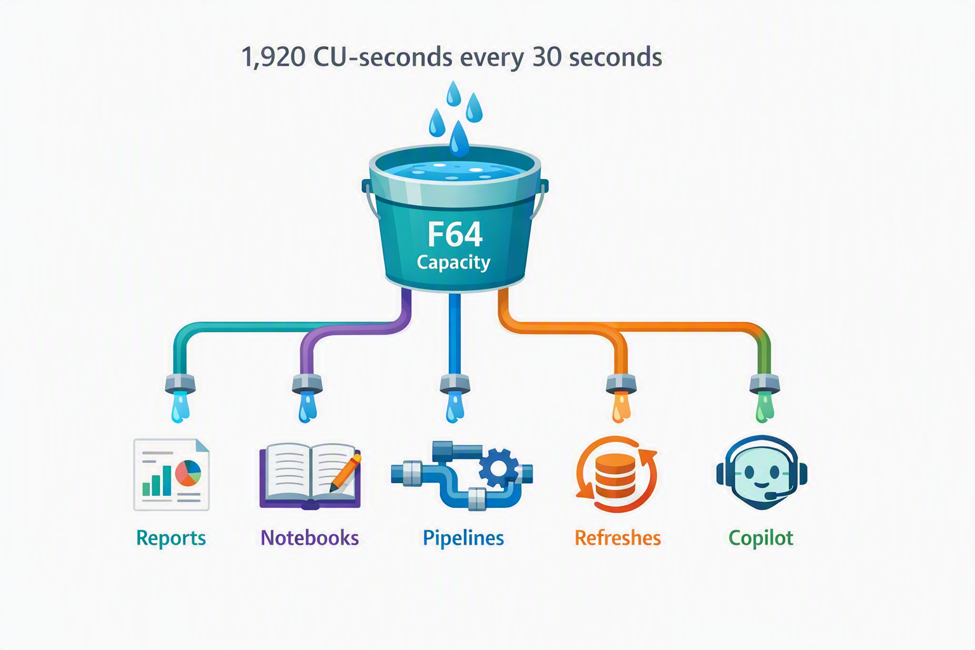
The blessing?
That shared-capacity model is the benefit. Fabric brings data engineering, data orchestration, real-time intelligence, machine learning, and business intelligence into one platform. Because those workloads share the same capacity, the CUs you pay for can be used wherever demand appears instead of being locked into separate services.
The curse?
That shared model is where things get tricky. Fabric operations are classified as interactive or background operations; Microsoft provides the full operation list here. Interactive usage is charged to the current time window, while background usage is smoothed over the next 24 hours. Fabric may give a notebook, pipeline, or refresh the resources it needs to finish quickly, but that consumption continues to affect the capacity throughout the smoothing period. If background work has already consumed most of the available headroom—I have seen it reach 90% of an F64—there is little room left when users open reports or start other interactive work. That’s when things can go… oops.
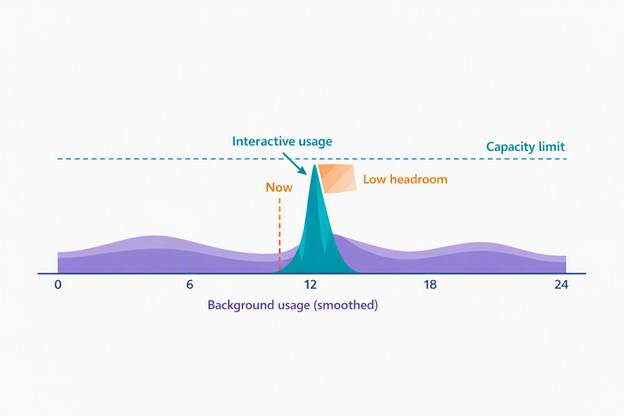
That is how a capacity can end up in “Fabric Jail.” Next week, I’ll dig into smoothing, explain what triggers throttling, and show you how to spot the warning signs before users feel the impact.

